The power goes out at 2 a.m. in a storm. The fridge starts warming, the sump pump sits dead while water creeps toward the basement floor, and the furnace blower will not move a degree of warm air. A portable generator is the fastest honest fix for that night: the right-sized unit restores the essentials in under an hour, for a few hundred dollars, with no permanent installation.
The catch is the right-sized part – buy too small and it trips every time a motor starts; buy too big and you own a heavy, thirsty machine that never leaves the garage.
Table of Contents
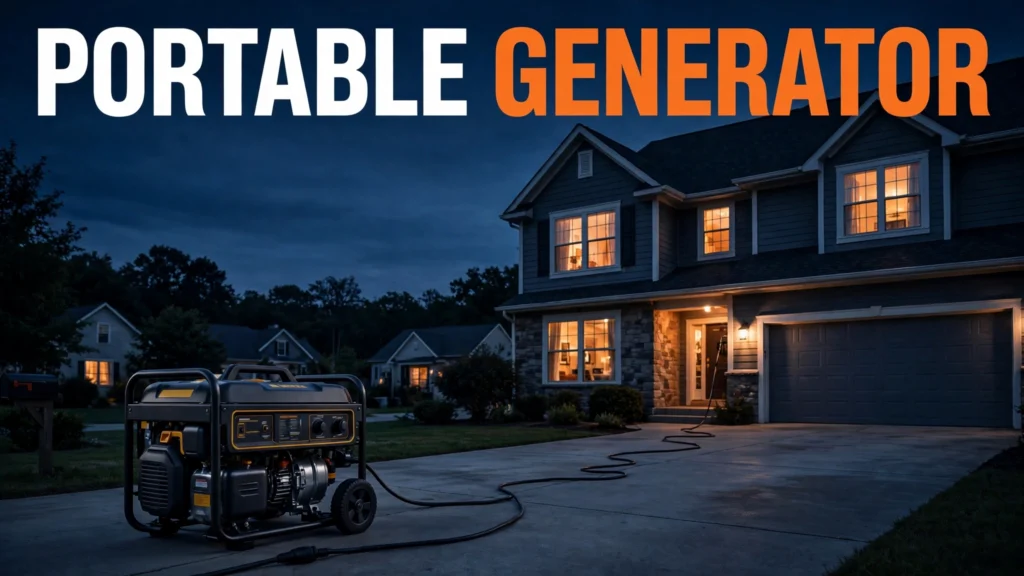
Is a Portable Generator the Right Fix for Your Outage?
Before you shop, match the symptom to the fix. A portable generator solves one problem – short-to-medium outages where a handful of circuits matter – and it is the wrong tool for others.
| Symptom | Likely cause | The fix |
|---|---|---|
| Power out, fridge warming, phones dying | Grid outage, no backup power at all | A portable generator sized for essentials (3,500-5,500 W) |
| Sump pump dead during a storm outage | No power to the pump while rain keeps coming | Generator power to the sump circuit – see our sump pump maintenance guide |
| Furnace runs but blower will not start | Gas furnace needs only electricity for the blower and controls | 500-900 running watts – see our furnace repair guide |
| Outages last days, several times a year | Frequent, long outages in your area | A permanently installed standby unit, not a portable |
| You need central AC through an outage | 3-ton AC needs 2,800-3,500 running watts plus a huge surge | 10,000 W+ portable at minimum – usually a standby unit instead |
If your outages are rare and measured in hours, a portable unit is the right call. If they are frequent and measured in days, price a standby system instead.
What Size Portable Generator Do You Need?
Sizing comes down to three numbers. Every appliance has a running wattage – the power it needs continuously – and motor-driven appliances also have a starting (surge) wattage, a brief burst two to three times higher that gets the motor spinning. A refrigerator hums along on about 700 watts but demands roughly 2,100 watts for the second its compressor kicks on. Size against the surge, or the unit trips at 2 a.m. when the well pump starts.
The method is simple: add up the running watts of everything you want on at the same time, add the single largest surge, then add about 20% headroom and round up to the next standard size.
| Appliance | Running watts | Starting watts |
|---|---|---|
| Refrigerator / freezer | 700 | 2,100 |
| Sump pump | 800 | 2,400 |
| Gas furnace blower | 500-900 | 1,800-2,600 |
| Window AC (10,000 BTU) | 1,200 | 3,600 |
| Well pump (1/2 HP) | 1,000 | 3,000 |
Worked example – the essentials kit: fridge (700) + sump pump (800) + furnace blower (800) + lights and router (200) = 2,500 running watts. Add the largest surge, the sump pump’s extra 1,600, and you get 4,100 watts; add 20% headroom and you land at about 4,900 – so a 5,000-5,500-watt portable generator is the sweet spot for most houses. That is why the 5,500-watt class is the best-selling outage size in America.
Three sizing rules the spec sheets skip: dual-fuel models make about 10% fewer watts on propane than on gasoline, so size against the propane rating if that is your main fuel. Small engines lose roughly 3% of output per 1,000 feet of elevation. And generators are most efficient at 50-80% load – a 12,000-watt unit loafing along at 2,000 watts burns more fuel per useful watt than a right-sized 5,500-watt unit.
Inverter or Conventional – Which One Fits Your House?
A conventional portable generator runs its engine at a fixed speed and is the cheaper way to get raw watts: a 5,500-watt conventional unit runs roughly $500-$900. An inverter generator varies engine speed with load, so it is quieter (often 52-60 decibels, about conversation level), sips fuel at light load, and produces clean power safe for laptops, phones, and modern furnace control boards. The trade is price: an inverter in the same wattage class runs roughly $900-$1,800, and above about 7,500 watts the choice is made for you – inverter models that large are rare and expensive.
Pick the inverter if you will run electronics directly, camp or tailgate with it, or value quiet at night. Pick conventional if your loads are motors and heating elements through a transfer switch and every dollar counts.
Gasoline, Propane, or Dual-Fuel?
Gasoline is the default: available everywhere, and a 5 kW-class machine burns roughly 0.5-0.7 gallons per hour at 50% load, giving 6-12 hours per tank. The problem is storage – gasoline goes stale in months, so you need stabilizer and a rotation habit, and you cannot safely stockpile much of it.
Propane stores indefinitely, burns cleaner, and you can keep two 20-pound grill tanks on hand without a second thought. The trade is energy density: a gallon of propane holds less energy than a gallon of gasoline, and dual-fuel units lose about 10% of their rated watts on propane.
Dual-fuel is the practical answer for most homeowners. Run gasoline when the pumps are working and the outage is short; switch to propane when gas stations are down or your stored gasoline is gone. A dual-fuel unit typically costs $100-$200 more than its gasoline-only twin – cheap insurance for a storm week.
How Much Does a Portable Generator Cost?
The machine is only part of the bill. The connection to your house is the other part, and it is where DIY ends and a licensed electrician begins.
| Item | DIY cost | Pro cost | Time |
|---|---|---|---|
| Portable generator, 3,500-5,500 W conventional | $400-$900 | – | – |
| Portable generator, 3,500-5,500 W inverter | $900-$1,800 | – | – |
| Portable generator, 7,500-9,500 W | $900-$2,000 | – | – |
| Heavy-duty extension cords (12-gauge, 25 ft) | $40-$80 each | – | – |
| Manual transfer switch + inlet box, installed | – | $500-$1,200 | 2-4 hours |
| Interlock kit + inlet, installed | – | $300-$700 | 1-3 hours |
| Standby generator, installed (comparison) | – | $8,000-$16,000 | 1-3 days |
| First oil change + spare spark plug + stabilizer | $25-$50 | – | 30 minutes |
The honest total for most houses: $700-$1,500 for the unit, cords, and fuel, plus $300-$1,200 if you want a safe, code-legal connection to the panel. Never backfeed a generator through a dryer outlet with a suicide cord – it can kill a line worker restoring power, and it is illegal in most states. A transfer switch or interlock kit is the only safe way to power house circuits, and both need an electrician.
How to Run It Safely – The Rules That Actually Matter
Carbon monoxide is the danger that kills people with generators, not the electricity. Portable generators were tied to an estimated 765 non-fire carbon monoxide deaths in the United States over the 2009-2019 decade – more than 75 a year, most often from running one too close to a home. The CDC’s rule is blunt: run it outdoors only, more than 20 feet from windows, doors, and vents, with the exhaust pointed away from the house. Never in a garage, even with the door open. The CDC’s carbon monoxide basics page spells out the placement rules and the detector guidance: https://www.cdc.gov/carbon-monoxide/about/index.html
Practical running habits: keep a battery-powered CO detector in the house whenever the generator runs, and a second one near sleeping areas. Let the engine cool before refueling – gasoline on a hot muffler is how fires start. Run it 20-30 minutes every month under a real load so the carburetor stays clean and you discover problems in daylight, not in a storm.
Change the oil after the first 20-25 hours, then every 50-100 hours; most portable units hold less than a quart, so it is a ten-minute job. One detail only someone who has done this knows: test-start the unit before storm season, choke set right – a flooded engine at 2 a.m. in the rain is a miserable place to learn the choke positions.
When to Call a Pro – Stop Here
- You want house circuits powered through the panel: a transfer switch or interlock kit is electrician work, full stop.
- The generator will not start, surges, or stalls under load after fresh fuel, a clean air filter, and a new spark plug: that is carburetor or governor work.
- You smell gas, see fuel leaking, or the unit ran indoors even briefly: ventilate, get everyone out, and call for help – do not restart it.
- Your panel is full, old, or has no room for a transfer-switch breaker: an electrician sizes the fix; never DIY the panel.
Portable Generator FAQs
How much does a portable generator cost?
A conventional 3,500-5,500-watt unit runs $400-$900, an inverter in the same class $900-$1,800, and a 7,500-9,500-watt unit $900-$2,000. Add $40-$80 per heavy-duty cord, and $300-$1,200 for a professionally installed transfer switch or interlock kit.
What size portable generator do I need for my house?
Most homes land at 5,000-5,500 watts for the essentials – fridge, sump pump, furnace blower, lights, and chargers – with 20% headroom built in. Add up your running watts, add the single largest motor surge, multiply by 1.2, and round up.
How many watts to run a refrigerator and furnace?
A refrigerator needs about 700 running watts and 2,100 starting watts; a gas furnace blower needs 500-900 running watts and up to 2,600 starting watts. Together with lights and chargers, a 3,500-watt unit covers both.
Inverter vs conventional generator – which is better?
An inverter is quieter, lighter on fuel at partial load, and safe for sensitive electronics, but costs roughly twice as much per watt. A conventional unit is the better value when your loads are motors and heaters wired through a transfer switch.
Gas or propane – which fuel is better for a portable generator?
Gasoline is cheaper per watt and available everywhere, but goes stale in months. Propane stores indefinitely and burns cleaner, but costs more per hour and cuts output about 10% on dual-fuel units. Dual-fuel gives you both options, which is why it is the default recommendation for storm backup.
Can I run a portable generator in my garage?
No. Never run one indoors or in a garage, even with the doors and windows open. Carbon monoxide builds up fast and has no smell. Run it outdoors, more than 20 feet from the house, exhaust pointed away from windows, doors, and vents, with a battery-powered CO detector inside the house.
Do I need a transfer switch or can I use extension cords?
Extension cords are fine for a few appliances – run a 12-gauge cord to the fridge and one to the sump pump. But cords cannot power hardwired things like a furnace blower, and they cannot be used to backfeed the panel. If you want circuits powered, a manual transfer switch or interlock kit installed by a licensed electrician is the only safe, legal route.
Final Thoughts
A portable generator is the cheapest real backup power a homeowner can own – but only if you buy it before the storm and size it on paper first. Work out your watts, add the biggest surge and 20% headroom, and buy the 5,500-watt class most houses need. Spend the extra on dual-fuel, budget for the transfer switch, and respect the 20-foot rule every time you start it.