If your family has ever fought over who gets the last of the hot water, a tankless water heater sounds like the perfect fix: endless hot water, no giant tank eating floor space, and lower energy bills. Here is the honest verdict up front. One is worth the money for households of three or more people, homes with a big soaking tub, or anyone replacing a dead tank heater anyway. It is a poor buy for a one- or two-person household with a nearly new tank, or for a home where the gas line and venting would need a four-figure upgrade.
Table of Contents
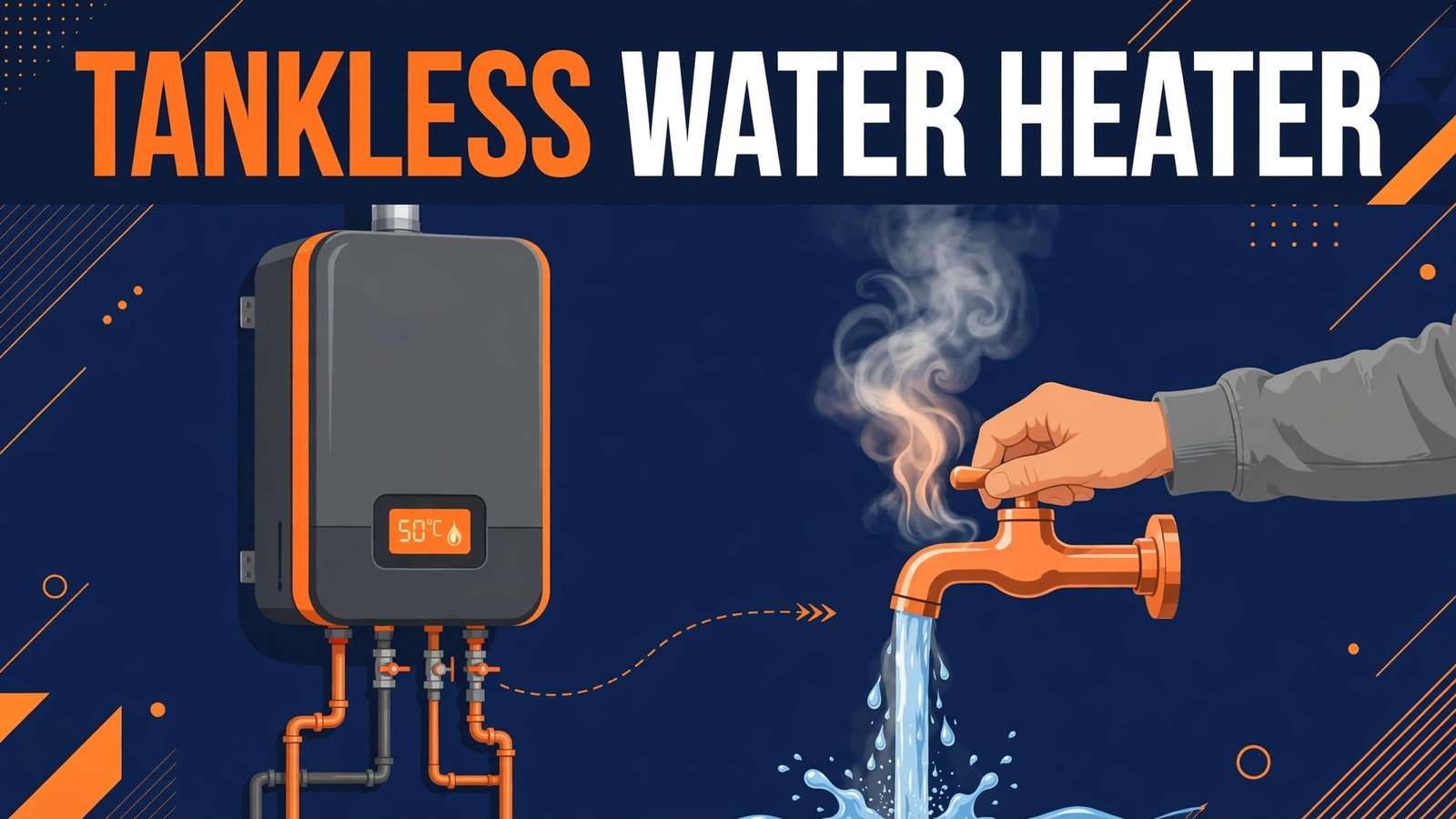
How a Tankless Water Heater Actually Works
A conventional tank heater keeps 40 or 50 gallons of water hot around the clock, burning gas or electricity all day whether anyone showers or not. A tankless unit does the opposite. Cold water flows through a heat exchanger only when a tap opens, a gas burner or electric element fires up, and the water is heated on its way to the shower. Close the tap and the unit shuts off — no tank to refill, no recovery time, and no standby heat loss, which is why the U.S. Department of Energy credits tankless units with 24–34% better energy efficiency than a standard tank for homes using 41 gallons or less of hot water a day.
There is one quirk every owner meets in the first week: the cold-water sandwich. Turn a tap off and back on quickly and the water sitting in the pipes has cooled, so you get a short burst of cold water between hot. It is normal, not a defect, and the most common “my tankless water heater is broken” call that is not actually a breakdown.
Is a Tankless Water Heater Right for Your Home?
| Your situation | Verdict | Why |
|---|---|---|
| 3+ people, showers back to back | Strong yes | Endless supply ends the morning queue |
| Big soaking tub (60+ gallons) | Yes | A tank empties before the tub fills |
| Replacing a dead tank heater | Yes | The cost gap is smallest when you are buying anyway |
| 1–2 people, tank under 5 years old | No | Payback stretches past 15 years |
| Gas line too small, no upgrade budget | No | A $1,500–$2,500 gas-line upgrade kills the math |
| Very hard water, no softener planned | Maybe | Yearly descaling becomes mandatory, not optional |
What Size Tankless Water Heater Do You Need?
Tankless units are not sized in gallons. They are sized in gallons per minute (GPM) at a given temperature rise — how much cold incoming water the unit must warm, and by how many degrees. Get this wrong and the unit physically cannot keep up, no matter the brand.
Fixture flow rates (ENERGY STAR averages):
| Fixture | Flow rate |
|---|---|
| Shower or bathtub | 2.5 GPM |
| Clothes washer | 3.3 GPM |
| Kitchen or bathroom sink | 2.2 GPM |
| Dishwasher | 1.3 GPM |
Add up the fixtures you realistically run at the same time. Two showers plus a dishwasher is 2.5 + 2.5 + 1.3 = 6.3 GPM. Then check the temperature rise: if your incoming water is 50°F in winter and you want 120°F at the tap, that is a 70°F rise. A unit rated 9 GPM at a 35°F rise may deliver only 5 GPM at a 70°F rise — check the manufacturer’s chart at your real winter rise, not the headline number.
One detail only an installer will tell you: a tankless unit needs a minimum flow rate — usually around 0.5 GPM — just to fire up. A dripping tap or a very low-flow faucet may never trigger it, so you get cold water from a tap that is technically “on.”
Gas vs Electric Tankless Water Heater
| Spec | Gas (non-condensing) | Gas (condensing) | Electric |
|---|---|---|---|
| Heating power | 140,000–199,000 BTU | 150,000–199,000 BTU | 18–36 kW |
| Energy factor | 0.82–0.85 | 0.90–0.98 | 0.99 |
| Venting | Metal flue, through roof | PVC, through wall | None |
| Gas line | 3/4-inch, often an upgrade | 3/4-inch, often an upgrade | 200-amp panel usually needed |
| Best for | Whole-home replacement | Cold climates, max efficiency | Small homes, warm climates, point-of-use |
| Cold-climate performance | Strong | Strongest | Weak — winter inlet water is too cold |
Gas wins for whole-home use in most of the United States. Electric units are simpler and cheaper to install — no vent, no gas line — but a 27 kW electric unit pulls 112 amps on its own, which means many 100-amp homes need a panel upgrade that costs more than the heater.
Tankless Water Heater Cost: The Real Numbers
| Line item | Typical range |
|---|---|
| Gas unit (whole-home) | $1,000–$2,500 |
| Electric unit (whole-home) | $500–$1,000 |
| Professional installation | $1,000–$2,000 |
| Gas-line upgrade (if needed) | $500–$2,500 |
| Venting (new or rerouted) | $300–$1,000 |
| Permit | $50–$250 |
| Condensate drain (condensing gas) | $100–$300 |
| Total installed, gas | $2,500–$6,500 |
| Total installed, electric | $1,500–$3,000 |
A standard 50-gallon tank replacement, by comparison, runs $1,200–$2,500 installed. At $100–$200 a year in energy savings, a gas tankless unit pays back its premium in roughly 8–12 years and lasts 20+ years, about double a tank’s life. Our full replacement guide covers the tank side of this decision: water heater replacement.
Installation: What the Job Actually Involves
A straightforward swap — old tank out, tankless unit on the wall in the same spot, gas and water lines already the right size — takes a licensed plumber 4–6 hours. Most jobs are not straightforward. The three surprises that blow up the quote are the gas line, the vent, and the water quality.
A tank heater sips gas at 40,000 BTU; a whole-home tankless unit can demand 199,000 BTU the moment a shower opens, so a 1/2-inch gas line that fed your old tank cannot feed it — the upgrade may mean a new run from the meter, the most common four-figure surprise in the job. Get the gas-line size confirmed in writing before you buy the unit.
Non-condensing gas units need a stainless-steel flue and cannot share a vent with a furnace; condensing units vent through PVC out a side wall but produce acidic condensate that must drain to a floor drain or a condensate pump. And hard water is the slow killer of a tankless unit: scale builds up inside the heat exchanger, efficiency drops, and the unit throws error codes. Budget for a scale filter or a softener and a yearly descale.
Tankless Water Heater Problems and Fixes
| Symptom | Likely cause | Fix | DIY or pro? |
|---|---|---|---|
| Short burst of cold water mid-shower | Cold-water sandwich | Normal — add a recirculation pump if it bothers you | DIY |
| Lukewarm water at every tap | Unit undersized for the GPM demand | Reduce simultaneous use, or upsize the unit | Pro |
| Water never gets hot at a low-flow tap | Flow below the 0.5 GPM minimum to fire | Open the tap further; check the activation rate | DIY |
| Error code / unit shuts down | Scale buildup in the heat exchanger | Descale with vinegar (see below) | DIY |
| Hot water then cold, then hot | Flow sensor or gas supply fluctuation | Check gas pressure and the inlet filter screen | Pro if gas-related |
Before assuming the heater is at fault, check your home’s water pressure — low flow starves a tankless unit. Our guide to fixing low water pressure walks through the checks that cost nothing.
Maintenance: Descaling Once a Year
Annual descaling is the one maintenance job that actually matters, and it takes 45–60 minutes. You need a descaling kit (a small submersible pump, two hoses, and a bucket — $60–$100) and 4–5 gallons of plain white vinegar. Close the isolation valves, circulate vinegar through the heat exchanger for 45 minutes, flush with clean water for 5 minutes, and reopen the valves. Homes with hard water should never skip a year. Our step-by-step for flushing a standard tank heater uses the same isolation-valve logic: how to flush a water heater.
When to Call a Pro — Stop and Get Help
- You smell gas at any point — leave the house and call your gas utility from outside. Never troubleshoot a gas appliance when you smell gas.
- The unit throws a combustion or venting error code — this is a carbon-monoxide risk, not a DIY reset.
- The install needs a gas-line upgrade, a new vent route, or a panel upgrade — all licensed work, and all permit work in most areas.
- Water is leaking from inside the unit casing rather than from a visible fitting — the heat exchanger itself may be cracked.
- The unit is less than a year old and already scaling up — you need a water-treatment plan, not another descale.
Frequently Asked Questions
How does a tankless water heater work?
Cold water flows through a heat exchanger only when a tap opens, and a gas burner or electric element heats it instantly on the way to the fixture. There is no storage tank, so there is no standby heat loss and no recovery wait — but the unit must be sized to your peak flow rate or the water comes out lukewarm.
What size tankless water heater do I need?
Add up the flow rates of the fixtures you run at the same time — a shower is about 2.5 GPM, a dishwasher about 1.3 GPM — then check the unit’s rating at your winter temperature rise, not its headline number. Most 2-bathroom homes need 6–7 GPM at a 70°F rise, which usually means a 180,000–199,000 BTU gas unit.
Are tankless water heaters worth it?
For households of three or more, or homes with a large soaking tub, yes — endless hot water and a 20+ year lifespan usually justify the $1,000–$2,000 premium over a tank. For one or two people with a nearly new tank, the payback stretches past 15 years.
How long do tankless water heaters last?
A well-maintained tankless water heater lasts 20 years or more, roughly double a tank heater’s 10–12 years. The key word is maintained — annual descaling in hard-water homes is what separates the 20-year units from the ones that fail at year eight.
Do tankless water heaters need maintenance?
Yes — an annual vinegar descale to remove mineral buildup from the heat exchanger, plus a yearly check of the inlet filter screen and venting. It takes under an hour with a $60–$100 pump kit, and skipping it is the fastest way to kill an expensive heater early.
Final Thoughts
A tankless water heater is one of the few home upgrades that genuinely changes daily life — the end of cold showers and a wall-mounted box where a rusting tank used to stand. It is also one of the upgrades most often bought wrong, because the headline price hides the gas line, the venting, and the sizing math. Size it by your real simultaneous flow rate at your real winter temperature rise, get the gas line confirmed in writing before you buy, and budget for a yearly descale. Do those three things and it will quietly do its job for twenty years.