A pressure washer can blast years of grime off a driveway in a single afternoon — or carve permanent stripes into your siding if you hold the wand wrong. Learning how to use a pressure washer correctly is the difference between a satisfying weekend transformation and an expensive repair bill. This guide walks you through the same process professionals use, from picking the right machine to rinsing the last soap away.
Below are nine proven steps in the order you would actually do them, plus nozzle and pressure settings for every common surface, the things you should never pressure wash, and answers to the questions homeowners ask most. Work through this guide on how to use a pressure washer in order, and your home’s exterior will look years newer by sundown.
Table of Contents
Choose the Right Pressure Washer and Gear
Pressure washers come in two families. Electric models (typically 1,500–2,000 psi) are quiet, light, and fine for siding, cars, and patio furniture. Gas models (2,500–4,200 psi) chew through stained driveways, old decks, and big jobs much faster, and a half-day rental runs roughly $30–$75 if you do not want to buy. Power is rated in psi (pounds per square inch) and gpm (gallons per minute); multiply the two and you get cleaning units, which is the truest measure of grunt.
Whichever machine you pick, learning how to use a pressure washer starts with the right nozzle: the color-coded tips — red 0°, yellow 15°, green 25°, white 40°, black soap — each cut very differently, and grabbing the wrong one is the most common rookie mistake of all.
How to Use a Pressure Washer in 9 Proven Steps
Follow these steps in order the first time out. Every step in this guide on how to use a pressure washer builds on the last one, so by Step 9 you will be working with real, confident technique.
Step 1: Prep and Protect the Area
Clear the work zone of furniture, toys, and anything breakable. Cover nearby plants with tarps — detergent and high-pressure runoff can scorch foliage — and close all windows and doors. Tape over outdoor outlets with duct tape, because water plus electricity is a hospital visit waiting to happen. If you are washing the house itself, check that window seals are tight so water does not end up on your sofa.
Step 2: Connect Water and Attach the Right Nozzle
Hook a garden hose to the washer’s water inlet and turn the spigot on full before starting the motor. Running the pump dry for even a minute can destroy the seals. Start with the white 40-degree tip for your test pass — it is the widest fan and the safest. This early caution matters in every guide on how to use a pressure washer, because the red 0-degree tip concentrates all the force into a needle that can cut skin and etch concrete.
Step 3: Start the Machine and Test in a Hidden Spot
Point the wand at the ground, squeeze the trigger, and let the trapped air purge out. Then test your technique in an inconspicuous spot: hold the tip about three feet from the surface and squeeze. If nothing happens, move in six inches at a time until the grime lifts — then hold that distance. The sweet spot is the farthest distance that still cleans, because knowing how to use a pressure washer is really about knowing where to stand.
Step 4: Apply Detergent from the Bottom Up
Snap on the black soap nozzle (it drops the pressure so the machine draws detergent) and spray your cleaner from the bottom of the surface upward in overlapping passes. Working upward prevents dirty runoff from streaking down over areas you have not touched yet. Let the soap dwell 5–10 minutes — never let it dry, especially in the sun — then you are ready to rinse. This order works the same on siding, driveways, and decks.
Step 5: Rinse Top to Bottom with Even Sweeps
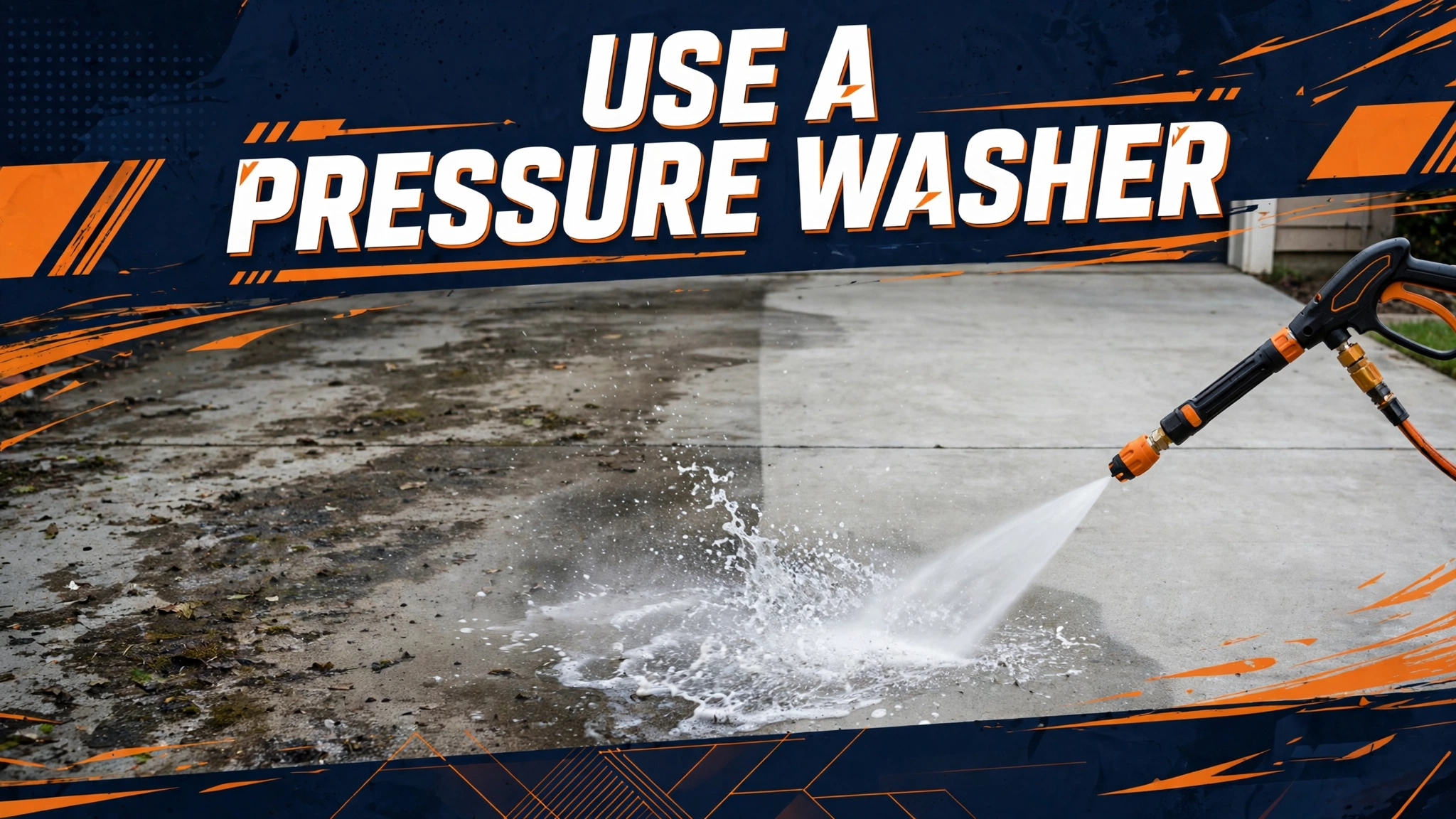
Switch back to the 25- or 40-degree tip and rinse from the top down, so dirty water flows away from your clean work. Keep the wand moving in smooth side-to-side sweeps, overlap each pass by about a third, and flick the trigger release at the end of every pass so you do not leave a gouge where you stopped. The single biggest sign of someone who never learned how to use a pressure washer is “tiger striping” — visible stop-and-start lines all over the driveway.
Step 6: Clean the Driveway in Sections
For concrete, the yellow 15-degree tip at 2,500–3,000 psi cuts through oil and algae fast. Work in 10-foot squares so the detergent does not dry between steps, and angle the spray slightly so runoff flows toward the street, not into your garage. If your driveway has deep cracks, high pressure can push water underneath and make them worse — our guide on how to repair concrete cracks covers sealing them before you wash.
Step 7: Wash Siding at Low Pressure
Siding needs finesse, not force. Drop to 1,200–1,500 psi with the white 40-degree tip, keep the tip 12–18 inches away, and angle the spray downward at about 45 degrees so you do not drive water behind the panels — trapped water rots sheathing and breeds mold. Vinyl and aluminum handle this fine, but never pressure wash fiber-cement siding, since it can void the warranty. If you are prepping for paint, budget two full dry days before the first coat. Our guide on how to clean gutters pairs well with this step, since your rinse water ends up in the gutters anyway.
Step 8: Refresh the Deck Without Gouging Wood
Wood is the surface that punishes mistakes hardest. Use 500–1,200 psi with the 40-degree tip held 9–12 inches out, and move with the grain — never hold the spray in one spot, or you will carve permanent furrows. Softwoods like cedar and pine are especially easy to damage. The pro move for learning how to use a pressure washer on a deck: treat the whole job as “just enough pressure to lift the gray,” and let the detergent do the heavy work instead of the jet.
Step 9: Shut Down, Flush, and Store Properly
When you are done, switch the machine off and squeeze the trigger to release trapped pressure before disconnecting anything. Flush the detergent line with clean water so it does not clog, and on gas models run the carburetor dry if you are storing it long term. Coil hoses loosely, store the nozzles where you can find them, and drain any remaining water if freezing weather is coming. A clean shutdown is the quiet ending to knowing how to use a pressure washer well, and it doubles your machine’s life.
How to Use a Pressure Washer Without Damaging Surfaces
The damage chart every first-timer needs: concrete and brick take 2,500–3,000 psi with the 15-degree tip; vinyl and aluminum siding take 1,200–1,500 psi with the 40-degree tip; painted wood siding takes 1,000–1,200 psi; softwood decks take 500–600 psi; patio furniture and cars take 1,200–1,900 psi with the 40-degree tip held at least two feet away. Distance is your throttle — double the distance and the impact force drops dramatically, so when in doubt, back up. The golden rule of how to use a pressure washer safely is simple: start far, move closer in small steps, and never linger in one spot.
What Not to Pressure Wash
Some things should never meet a pressure washer, no matter how satisfying it looks: asphalt shingles (the protective granules blast right off — see our guide on how to clean a roof without damaging shingles for the safe approach), lead paint (the chips become a hazardous-waste problem), old mortar between bricks, windows and screens (water gets forced past the seals), and air-conditioner condenser fins (they bend permanently). If a surface is already cracked, flaking, or fragile, the washer will finish the job.
FAQs About How to Use a Pressure Washer
How much PSI do I need for a driveway?
2,500–3,000 psi handles oil stains and ground-in dirt on concrete. Lighter 2,000-psi electric units will clean a driveway too — it just takes longer, and you may need a second detergent pass on the worst stains.
Can I use a pressure washer on my car’s paint?
Yes, with the 40-degree tip at least two to three feet away and pressure under 2,000 psi. Never use the 0-degree or 15-degree tip on paint, and keep the spray moving — holding still can strip clear coat. A foam-cannon attachment makes the detergent step much safer on cars.
Do I really need detergent, or is water enough?
Water alone removes loose dirt, but detergent breaks the bond of mildew, algae, and oil so you can rinse at lower pressure — which is gentler on every surface. Anyone learning how to use a pressure washer should treat soap as the main cleaner and pressure as the assistant.
How do I avoid stripes and streaks on concrete?
Work in small sections so soap never dries, overlap each pass by a third, keep a consistent distance, and release the trigger at the end of each sweep instead of stopping mid-pass. Rinsing top-to-bottom also keeps dirty water from re-staining cleaned areas.
Is it safe to pressure wash a house’s siding?
Yes for vinyl, aluminum, wood, and most stucco at low pressure — but knowing how to use a pressure washer on siding means keeping the spray angled downward and the pressure low so water never gets forced behind the panels. Skip fiber-cement siding and any siding with loose or damaged boards.
Final Thoughts
A pressure washer is one of the most satisfying tools a homeowner can own — few things transform a home’s look faster than a Saturday afternoon with the wand. Take the setup seriously, respect the pressure, and let the detergent do the work, and you will get professional-looking results on your very first try. Once you know how to use a pressure washer with proper technique, the driveway, the siding, and the deck are all afternoon projects instead of weekend-long ordeals. For more pro technique, Bob Vila’s pressure washer guide is worth a read.